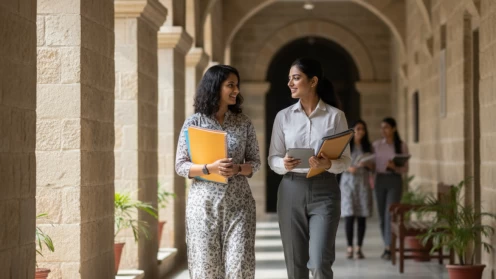
Distance MA Visual Arts is a postgraduate programme tailored for students who wish to pursue advanced studies in visual arts through a flexible, remote learning format. This mode of education is especially valuable in India, where geographical and professional commitments often make traditional, in-person courses less accessible. The curriculum is designed to cover various aspects of visual arts, including art history, contemporary practices, and new media forms, while providing the convenience of studying from anywhere.
With distance education, you receive course materials and guidance from your chosen university, allowing you to learn at your own pace. The Distance MA Visual Arts programme is regulated by the University Grants Commission (UGC) and the Distance Education Bureau (DEB), ensuring that the curriculum, evaluation, and certification processes meet the highest educational standards set for Indian universities. This ensures that your degree holds the same value as any regular mode qualification.
The course is structured to cater to both recent graduates and mid-career professionals seeking to enhance their creative and analytical skills. Through a blend of theoretical knowledge and practical assignments, students are equipped to contribute to India’s growing art and design sectors. By choosing distance education, you unlock the potential to pursue your passion for art without compromising on existing responsibilities.
Whether your goal is to become a practising artist, an educator, or a curator, a Distance MA in Visual Arts can open doors to diverse career paths in the vibrant Indian arts ecosystem.
Who Should Choose Distance MA Visual Arts?
The Distance MA Visual Arts programme is best suited for individuals who are passionate about the arts but may face constraints that prevent full-time, on-campus study. If you are a working professional, homemaker, or reside in a location far from major educational hubs, this mode of study allows you to balance your education with personal and professional commitments.
Recent graduates who wish to pursue higher studies while preparing for competitive examinations or exploring job opportunities can also benefit from the flexibility offered by distance learning. The programme is ideal for those who are self-motivated, disciplined, and able to manage their own study schedules.
If you are looking to shift careers or upgrade your qualifications in the visual arts domain, distance education provides an affordable and accessible pathway. It is particularly suitable for individuals seeking skill enhancement for creative roles in educational institutions, art galleries, museums, or the media industry.
Moreover, candidates who wish to explore interdisciplinary applications of visual arts in fields like digital media, advertising, and design can leverage this course to build a strong academic and practical foundation.
Eligibility Criteria and Admission Requirements
To enrol in a Distance MA Visual Arts programme, you must hold a recognised Bachelor’s degree from a UGC-approved university. While some universities accept graduates from any discipline, others may require a background in arts or a related field. It is common for institutions to specify a minimum qualifying percentage, typically around 50% in the undergraduate programme, although this can vary.
In addition to academic qualifications, certain universities may conduct entrance examinations or evaluate candidates based on merit. You should check the specific eligibility criteria on the official website of your chosen university before applying.
Other essential requirements often include providing scanned copies of your academic transcripts, proof of identity, and passport-sized photographs. If you are applying under reserved categories, you may be required to submit relevant certificates as per government norms.
Always ensure that you thoroughly review the eligibility details and admission requirements to avoid any last-minute discrepancies during the application process.
Step-by-Step Admission Process
The admission process for Distance MA Visual Arts generally follows a structured approach to ensure transparency and ease for prospective students. Here’s a step-by-step guide to help you:
- Step 1: Research and Shortlist
Visit the official websites of UGC-DEB approved universities offering the Distance MA Visual Arts programme. Compare their fee structures, syllabi, eligibility criteria, and admission cycles. - Step 2: Register Online
Most universities facilitate online registration. Create an account on the university portal and fill in your personal and educational details as required. - Step 3: Upload Documents
Scan and upload necessary documents such as academic certificates, identity proof, passport-sized photographs, and category certificates (if applicable). - Step 4: Pay Application Fee
Pay the application fee online via net banking, UPI, or debit/credit card. Retain the receipt for future reference. - Step 5: Entrance Test/Merit Evaluation
If applicable, appear for the entrance test or await merit-based selection. Some universities may conduct interviews or require portfolio submissions. - Step 6: Admission Confirmation
Once shortlisted, pay the course fees to confirm your admission. You will receive an official admission letter and further instructions regarding course commencement.
Always keep a copy of all submitted documents and receipts. Regularly check your email and the university portal for updates regarding your application status.
Course Duration and Fee Structure
The Distance MA Visual Arts programme typically spans two years, divided into four semesters. However, some universities may offer extended durations for working professionals or those who require additional time to complete the coursework.
Fee structures can vary significantly depending on the university and its location. On average, the annual fee ranges from ₹15,000 to ₹60,000. Some universities may offer the option to pay fees semester-wise or in instalments, providing added flexibility for students from diverse financial backgrounds.
It is important to note that government and government-aided universities often have lower fee structures compared to private institutions. Fee waivers or scholarships may be available for students belonging to reserved categories or those with outstanding academic records.
Check the specific fee breakdown, including tuition, examination, and registration charges, before making your payment. Ensure you are aware of any refund policies in case you need to withdraw your application.
Hidden Costs and Practical Expenses
While the advertised course fee covers tuition and academic resources, there may be additional expenses that you should plan for. These can include:
- Study Materials: Although many universities provide study materials, you may wish to purchase supplementary textbooks or reference guides, which can add to your costs.
- Art Supplies: As a practical subject, visual arts often require materials such as paints, canvases, brushes, and digital tools. Budgeting for these is essential.
- Examination Fees: Some universities charge separate fees for semester or final examinations, which may not be included in the annual tuition.
- Travel and Accommodation: If the university mandates any in-person workshops, practicals, or examinations, you may incur travel and lodging expenses.
- Internet Connectivity: A reliable internet connection is necessary for accessing online resources, submitting assignments, and attending virtual workshops.
Keep these practical expenses in mind while planning your budget for the course. It is advisable to contact your university for a detailed breakdown of all potential costs before enrolling.
Is Distance MA Visual Arts Valid?
Distance MA Visual Arts degrees awarded by UGC-DEB approved universities in India are fully valid and recognised for employment, higher studies, and competitive examinations. The UGC (University Grants Commission) and DEB (Distance Education Bureau) regulate and monitor the quality and standard of distance programmes, ensuring parity with regular mode degrees.
It is crucial to enrol only in programmes offered by universities that are recognised by the UGC and listed by the DEB for distance education. Such degrees are accepted by government and private sector employers, as well as for pursuing MPhil, PhD, or academic positions in India.
However, you should note that certain job roles, especially in teaching and government sectors, may require you to clear additional eligibility tests or meet specific subject requirements. Always verify the recognition status of your desired programme and its acceptance in your intended career path before enrolling.
Distance education is a legitimate and respected mode of learning in India, provided the university is appropriately approved by regulatory authorities.
How to Verify University Approval
Before enrolling, it is essential to verify that the university offering the Distance MA Visual Arts is UGC and DEB approved. This can be done by following these steps:
- Visit the UGC Official Website and check the list of recognised universities.
- Refer to the Distance Education Bureau (DEB) portal to confirm if your chosen university and course are approved for distance education.
- Always cross-check the university’s name, address, and course listing to avoid confusion with similarly named institutions.
If you are uncertain, you may contact the admissions office of the university or send an enquiry to the UGC or DEB for clarification. Never rely solely on third-party websites or agents for verification, as this could lead to misinformation or potential fraud.
Comprehensive Syllabus and Subjects
The Distance MA Visual Arts syllabus is designed to offer both theoretical foundations and practical exposure. Common subjects and core modules include:
- History of Arts: Exploration of Indian and global art movements, styles, and significant artists.
- Visual Communication: Study of visual language, symbols, and their cultural significance.
- Contemporary Art Practices: Examination of modern and postmodern artistic trends, techniques, and media.
- Art Criticism: Analytical approaches to evaluating and interpreting artworks.
- Digital Arts: Introduction to digital media tools and creative practices in the digital realm.
- Photography and Photography Theory: Fundamentals of photography, composition, and visual storytelling.
- Indian Aesthetics: Study of traditional Indian art forms and aesthetic theories.
- Research Methodology: Techniques for conducting scholarly research in visual arts.
- Project Work/Dissertation: Independent research or creative project under faculty supervision.
Each university may have additional elective modules or specialised workshops tailored to specific art forms or media.
Learning Method and Examination Pattern
Distance MA Visual Arts programmes employ a blend of self-study, assignments, and periodic assessments. Study materials are typically provided in the form of printed books, e-books, and online resources. Some universities may also organise online lectures, webinars, or occasional contact classes at designated centres.
Assignments form an integral part of the evaluation process and may include practical exercises, essays, or portfolio submissions. Regular submission of assignments is mandatory to be eligible for semester-end examinations.
Examinations are usually held at authorised centres and may comprise written papers, viva voce, or practical demonstrations, depending on the nature of the subject. The overall assessment is a combination of internal assignments and external examinations.
This flexible learning method enables you to pace your studies according to your convenience, while still maintaining academic rigor and discipline.
Career Scope and Job Opportunities
Graduates of Distance MA Visual Arts enjoy a broad spectrum of career opportunities across India’s creative industries. You can pursue roles such as:
- Visual Artist
- Art Educator
- Art Curator
- Graphic Designer
- Exhibition Organiser
- Art Critic
- Photographer
- Illustrator
Employment can be found in art galleries, museums, schools and colleges, media houses, advertising agencies, publishing companies, and cultural organisations. The knowledge and skills gained also empower you to work as a freelancer or set up your own creative practice.
With the rise of digital media, there is increasing demand for professionals skilled in visual communication, digital arts, and multimedia design. The Distance MA Visual Arts prepares you for both traditional and emerging roles in India’s dynamic art ecosystem.
Additionally, the degree provides a pathway to pursue research, further studies (like MPhil or PhD), or teaching positions in reputed institutions.
Salary Expectations and Career Progression
Salaries for MA Visual Arts graduates vary depending on your chosen career path, location, and level of expertise. Entry-level positions such as graphic designer or art instructor may offer initial salaries ranging from ₹2,50,000 to ₹4,50,000 per annum. With experience and skill development, you can progress to senior roles like art director, curator, or academician, where salaries can exceed ₹7,00,000 per annum.
Freelancers and independent artists have the potential to earn variable incomes based on commissions, exhibitions, and projects. Continuous skill upgradation and networking within the art community can significantly enhance your earning potential and career growth.
Many graduates also opt for entrepreneurship, setting up their own studios, art consultancies, or online art platforms. Teaching and research roles in universities and colleges also offer stable career progression and income growth.
It is important to remember that passion, creativity, and persistence are key drivers of success in the visual arts sector, often leading to both personal satisfaction and professional recognition.
Distance vs Regular MA Visual Arts Comparison
| Aspect | Distance Mode | Regular Mode |
|---|---|---|
| Learning Format | Remote, self-paced, study materials | On-campus, classroom-based learning |
| Flexibility | High; suitable for working professionals | Fixed schedules; requires regular attendance |
| Cost | Generally lower fees | Varies; often higher due to campus facilities |
| Networking | Limited peer interaction | Greater opportunities for networking |
| Practical Exposure | Assignments and occasional workshops | Hands-on studio work and regular practicals |
Consider your personal and professional circumstances before choosing the appropriate mode.
Distance vs Online MA Visual Arts Comparison
| Aspect | Distance Mode | Online Mode |
|---|---|---|
| Course Delivery | Printed/emailed materials, postal assignments | Interactive online platforms, video lectures |
| Interaction | Limited, mostly via post/email | Real-time discussions, webinars, virtual classrooms |
| Assessment | Physical submissions, offline exams | Online quizzes, digital submissions |
| Flexibility | Self-paced, but may need to attend in-person for exams | Anytime, anywhere access; fully online exams possible |
Choose the mode that best fits your learning style and access to technology.
Top Distance Universities for MA Visual Arts
Several Indian universities, recognised by UGC and DEB, offer Distance MA Visual Arts programmes. Some notable examples include:
- University A
Eligibility: Bachelor’s degree required
Fees: ₹30,000 per annum
Syllabus: Includes Visual Communication, contemporary practices
Admission Cycles: January and July
Website: universityA.edu.in - University B
Eligibility: 50% in Bachelor’s required
Fees: ₹15,000 per annum
Syllabus: Covers Digital Arts, Art Criticism
Admission Cycles: July (applications open in May)
Website: universityB.ac.in - University C
Eligibility: Bachelor’s degree in any discipline
Fees: ₹25,000 per annum
Syllabus: Art History, Photography, etc.
Admission Cycles: Open throughout the year
Website: universityC.edu.in
Before applying, always review the latest details on the official university websites or contact their admissions offices for clarification.
Common Mistakes to Avoid While Choosing a University
Making an informed choice is crucial to ensuring a rewarding educational experience. Here are some common mistakes to avoid:
- Not verifying UGC/DEB approval: Always check the regulatory status of the university and the programme to ensure your degree will be valid.
- Ignoring hidden costs: Clarify all expenses before enrolling to avoid unexpected financial burdens.
- Overlooking faculty expertise: Research the credentials of teaching staff and their experience in the visual arts sector.
- Neglecting support services: Ensure the university offers adequate academic support, counselling, and grievance redressal mechanisms.
- Falling for misleading advertisements: Be wary of third-party agents and websites making unrealistic promises or offering fraudulent admissions.
Take the time to compare multiple universities and seek feedback from current students or alumni before making your final decision.
Conclusion: Is this Course Right for You?
Choosing a Distance MA Visual Arts can be a transformative step in your academic and professional journey. This flexible, affordable, and recognised programme is ideal for individuals who are passionate about the arts and require a non-traditional mode of learning.
By meeting the eligibility criteria, understanding the admission process, and planning for both visible and hidden expenses, you can set yourself up for success. The course offers a comprehensive curriculum, practical exposure, and a wide array of career opportunities in India’s dynamic creative industries.
Remember, the value of your degree is closely linked to the credibility of the university and your own commitment. By making informed choices and leveraging the resources available, you can turn your passion for visual arts into a fulfilling career path.
If you seek flexibility, quality, and recognition, a Distance MA Visual Arts from a UGC-DEB approved Indian university can be the perfect fit for your aspirations.