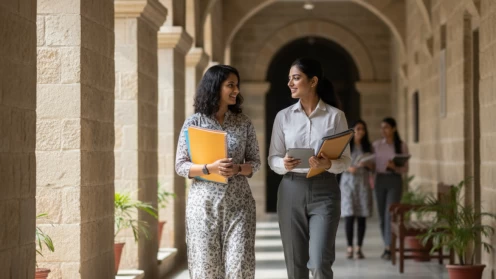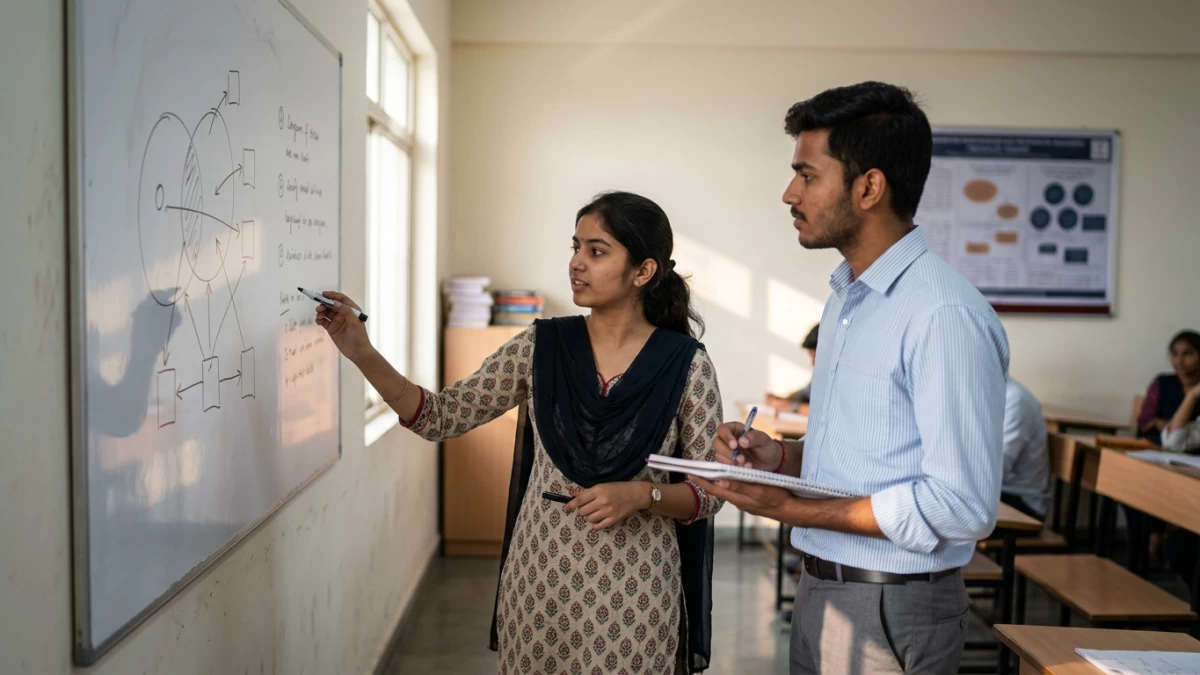
If you are passionate about books, information organisation, and digital library management, a Distance Master of Library and Information Science (M.Lib.I.Sc) can unlock a world of opportunities. This postgraduate programme, delivered through open and distance learning by UGC-DEB approved Indian universities, is designed to empower you with advanced knowledge and skills in library science. Whether you aspire to become a librarian, information manager, or research specialist, the course will prepare you for roles in educational institutions, research organisations, government bodies, and private sector information centres.
Distance M.Lib.I.Sc combines theoretical understanding with practical exposure to the latest trends in information science. The curriculum covers a wide spectrum, from library automation and digital libraries to information retrieval and research methods. By opting for distance education, you gain the flexibility to learn at your own pace, balancing your studies with professional or personal commitments.
Thanks to robust online platforms, you can access study material, attend virtual workshops, participate in forums, and interact with faculty and peers—all from the comfort of your home. This mode of learning is especially helpful for those living in remote locations or those engaged in jobs that make traditional classroom attendance challenging.
Most importantly, a Distance M.Lib.I.Sc degree from a recognised Indian university holds the same value as a regular, on-campus degree, ensuring your qualification is widely accepted across academic, public, and private sectors throughout India.
Course Recognition and Approval Status
One of the most crucial considerations when choosing a Distance M.Lib.I.Sc programme is its recognition status. In India, the University Grants Commission (UGC) and its Distance Education Bureau (DEB) oversee and regulate distance education programmes to ensure quality and credibility. A degree obtained from a UGC-DEB approved university is fully recognised for employment, higher studies, and professional advancement, both in government and private sectors.
For instance, institutions like Indira Gandhi National Open University (IGNOU), University of Mysore, Dr. B.R. Ambedkar Open University, and Tamil Nadu Open University (TNOU) hold UGC-DEB approval for their distance M.Lib.I.Sc programmes. Degrees from these universities are treated at par with those from conventional modes, ensuring you do not face any disadvantage in job applications or when applying for further studies.
It is important to check the latest UGC-DEB list of approved universities before enrolling, as only degrees from such institutions are considered valid by government agencies and employers. This regulatory framework serves as a safety net, protecting you from unrecognised or unaccredited courses that may not be accepted in the job market.
In summary, always ensure that your chosen distance M.Lib.I.Sc programme is offered by a UGC-DEB recognised university. This will provide you with a qualification that is both respected and versatile.
Eligibility Criteria and Duration
The entry requirements for Distance M.Lib.I.Sc programmes are straightforward, making it accessible to a wide range of aspirants. Typically, you need to possess a bachelor's degree in any discipline from a recognised university. There is no restriction regarding your undergraduate specialisation, which means graduates from arts, science, commerce, or any other stream can apply.
The duration of the programme generally varies between 1 and 2 years depending on the university's academic structure. For example, IGNOU offers a 1-year programme, while the University of Mysore and TNOU offer 2-year courses. This flexibility allows you to select a course structure that best fits your personal and professional schedule.
Some universities may require you to have a Bachelor of Library and Information Science (B.Lib.I.Sc) as a prerequisite, so always check the specific eligibility norms of your chosen institution. However, most commonly, any graduate degree suffices.
Distance education providers often offer admission cycles twice a year, giving you the convenience to apply at a suitable time. This is particularly beneficial if you are balancing work or family responsibilities along with your studies.
Who Should Consider This Course?
A Distance M.Lib.I.Sc is ideal for a diverse group of learners. If you are a working professional in a library, information centre, archive, or similar setting aiming to enhance your qualifications, this course offers a flexible pathway to career advancement. It is also well-suited for recent graduates who wish to specialise in library and information science without relocating or attending regular classes.
This programme is perfect for individuals with a keen interest in information organisation, digital resource management, and research. If you enjoy working with information systems or wish to contribute to knowledge dissemination in academic, public, or corporate libraries, you will find the curriculum both engaging and practical.
Educators, research scholars, and even those looking for a career transition into the information management sector can benefit greatly. The distance mode ensures that geographic location or time constraints do not hinder your educational aspirations.
If you are looking for a career that combines technology, information management, and public service, a Distance M.Lib.I.Sc is a promising choice. It opens doors to roles that are intellectually stimulating and socially impactful.
Admission Process and Fee Details
The admission process for Distance M.Lib.I.Sc programmes is generally user-friendly and can often be completed online. Most universities provide detailed instructions and online application forms on their official websites. You will need to submit your academic qualifications, identity proof, and sometimes a photograph, along with the application fee.
After initial screening, universities may issue a provisional admission letter. Some institutions may conduct a brief orientation to familiarise you with the course structure, online learning platforms, and support services. Admission is usually granted on a first-come, first-served basis, provided you meet the eligibility criteria.
The fee structure is one of the major advantages of distance education. The annual fees for Distance M.Lib.I.Sc programmes range from ₹10,000 to ₹50,000, depending on the university. For example, IGNOU charges around ₹12,000, whereas the University of Mysore's fee is about ₹20,000. These fees are comprehensive and typically include tuition, study materials, and access to online resources.
Some universities offer instalment payment options, scholarships, or fee waivers for reserved category students. Always verify the fee details on the official university website and be aware of any additional charges for study materials or examination fees.
Hidden Costs or Practical Requirements
One of the key attractions of distance learning is the absence of hidden costs. Most universities bundle tuition, study materials, and access to digital resources within the annual fee. However, a few incidental expenses may arise, such as internet connectivity, optional printed study materials, or certain examination fees if you choose to appear at a centre outside your state.
Practical components are usually designed to be student-friendly. Unlike traditional courses, most distance M.Lib.I.Sc programmes do not mandate in-person practical labs. Universities like Tamil Nadu Open University (TNOU) have innovated by offering online practical modules, workshops, or project-based assignments that you can complete remotely.
Some universities may recommend or offer optional workshops, webinars, or contact classes for hands-on experience in cataloguing, digital libraries, or library automation. Participation in these sessions is usually not compulsory, but it can enrich your learning and networking experience.
It is recommended to budget for basic IT equipment, such as a personal computer or laptop and reliable internet access, to make the most of online learning resources and communication platforms provided by the university.
Syllabus and Core Subjects
- Library and Society: Study the role of libraries in social and educational development.
- Information Processing & Retrieval: Learn about cataloguing, classification, and information retrieval systems.
- Library Management: Covers management principles, human resource management, and financial administration in libraries.
- Research Methods: Introduction to research design, data collection, and analysis in library science.
- Digital Libraries: Understand digital resource management, electronic content, and library automation.
- Information Technology Applications: Includes the use of computers, databases, and library management software.
- Project Work / Dissertation: Most programmes require a project or dissertation, allowing you to apply theoretical knowledge to practical issues.
The course is structured to balance traditional library science principles with emerging trends in digital information management, ensuring you are prepared for both conventional and modern library settings.
Career Scope and Salary Potential
Upon successful completion of your Distance M.Lib.I.Sc, a wide range of career opportunities become available. You are eligible for librarian positions in colleges, universities, schools, public libraries, research institutions, and special libraries. Many government and semi-government organisations also recruit information professionals through competitive exams and direct recruitment.
In addition to traditional librarian roles, you can explore careers as information analysts, digital resource managers, archivists, content developers, or knowledge managers in corporate and academic environments. The demand for library and information science professionals is steadily increasing, particularly with the rise of digital libraries and e-resources in India.
The starting salary for fresh M.Lib.I.Sc graduates typically ranges from ₹2.5 lakh to ₹5 lakh per annum, depending on the sector, location, and your prior experience. With experience and additional qualifications, you can advance to senior positions such as Chief Librarian, Information Scientist, or Library Director, where salaries can reach ₹8 lakh to ₹12 lakh per annum or more.
Continuous upskilling—such as certification in digital resource management or library automation—can further enhance your career prospects and salary potential.
Common Myths and Misunderstandings
There are several misconceptions surrounding distance education, especially in library science:
- Myth 1: Distance learning is not as credible as regular courses.
Fact: As per UGC norms, degrees from UGC-DEB approved universities in India hold equal recognition as regular degrees for jobs and further studies. - Myth 2: You cannot get a job with a Distance M.Lib.I.Sc.
Fact: Many government and private institutions accept distance M.Lib.I.Sc graduates for librarian and information officer roles. - Myth 3: Distance education lacks interaction with faculty.
Fact: Leading universities offer robust online support, including webinars, discussion forums, and email guidance to ensure student-faculty interaction.
It is crucial to base your decisions on facts and to choose only recognised institutions to maximise the value of your degree.
Top Institutes Offering This Course
| University | Duration | Approx Fees (₹) | Website |
|---|---|---|---|
| Indira Gandhi National Open University (IGNOU) | 1 year | 12,000 | www.ignou.ac.in |
| University of Mysore | 2 years | 20,000 | uni-mysore.ac.in |
| Dr. B.R. Ambedkar Open University | 1 year | 10,000 | braou.ac.in |
| Tamil Nadu Open University (TNOU) | 2 years | 15,000 | tnou.ac.in |
Each of these institutions is well-regarded and offers a comprehensive distance M.Lib.I.Sc programme in line with UGC-DEB norms. Explore their official websites for detailed admission notices, syllabus outlines, and student support services.
In conclusion, a Distance M.Lib.I.Sc is a viable, respected, and flexible path to a rewarding career in library and information science. With careful selection of a UGC-DEB approved university and a commitment to your studies, you can achieve both personal and professional growth in this ever-evolving field.