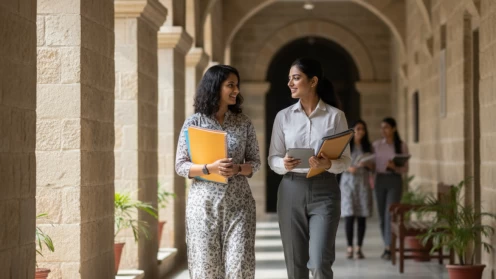
The Bachelor of Commerce (B.Com) in Corporate Secretaryship is a popular undergraduate degree in India, preparing you for key roles in corporate governance, administration, and compliance. With the growing demand for flexibility and accessibility in higher education, Indian universities now offer this programme in three distinct modes: Regular, Distance, and Online. Understanding the differences between these formats will help you choose the mode that best fits your educational needs, career goals, and lifestyle.
The Big Comparison Table: Distance vs Online vs Regular Mode
| Feature | Regular Mode | Distance Mode | Online Mode |
|---|---|---|---|
| Typical Fees (3 years) | ₹25,000 – ₹1,00,000 | ₹8,000 – ₹40,000 | ₹12,000 – ₹60,000 |
| Class Timings | Fixed (9 AM – 5 PM) | Flexible, self-paced | Live online (evenings/weekends), recorded lectures |
| Attendance Requirement | Mandatory (usually 75%) | None | Tracked, but not always mandatory |
| Exam Centres | On campus | Designated centres near your location | Online at set times |
| Certificate Value | No mention of mode | Often mentions 'Distance Mode' | May mention 'Online' or 'Distance' |
| Learning Environment | In-person, structured | Self-study, limited faculty interaction | Virtual, interactive (varies by university) |
Learning Flexibility Differences (Attendance & Schedules)
One of the most significant differences between Regular, Distance, and Online B.Com Corporate Secretaryship courses in India lies in the flexibility of learning schedules and attendance requirements.
Regular mode follows a traditional classroom format. You will attend classes on campus at fixed timings, usually from 9 AM to 5 PM on weekdays. This structure ensures regular interaction with faculty and peers, but it also means limited flexibility. Attendance is generally mandatory (typically 75%) and is closely monitored. Missing classes beyond the permissible limit can make you ineligible to sit for university exams.
Distance mode prioritises flexibility and self-paced learning. You can access study material at your convenience with no fixed class schedules. Some universities may invite you to occasional contact classes or workshops, but attendance is not compulsory. This makes the distance option ideal for working professionals, homemakers, or those with other responsibilities.
Online mode blends flexibility with more structured learning than distance education. While you may attend live classes (often scheduled in the evenings or on weekends), recorded lectures are also available, allowing you to revisit topics at your pace. Attendance is usually tracked in online classes, but it is not always mandatory. However, participation in live sessions can enhance understanding and interaction with faculty and classmates.
Curriculum & Syllabus Depth (Is Regular Harder?)
All three modes—Regular, Distance, and Online—must adhere to UGC and DEB guidelines, ensuring a standardised core curriculum across Indian universities. The B.Com Corporate Secretaryship syllabus typically covers foundational commerce subjects, business law, and specialised courses in corporate governance, company law, and secretarial practices.
- Business Communication
- Principles of Accountancy
- Business Law & Company Law
- Corporate Governance
- Secretarial Practice
- Financial Management
- Corporate Accounting
- Taxation Laws
- Business Ethics
- Entrepreneurial Development
- Management Information Systems
- Electives & Project Work
While the curriculum remains largely the same, the delivery and assessment methods differ. Regular mode is often perceived as more rigorous due to continuous in-person assessments, regular assignments, and classroom discussions. Distance and online modes require greater self-discipline since you must manage your own study schedule and keep up with assignments independently. Online mode may include interactive assessments, quizzes, and virtual discussions, depending on the university’s digital infrastructure.
Peer Learning & Networking (Campus vs Virtual)
Peer interaction and networking are important components of any undergraduate programme, especially in a field like Corporate Secretaryship where group projects, presentations, and case studies are common.
In Regular mode, the campus environment fosters spontaneous peer learning. You have daily opportunities to interact with classmates, participate in student societies, attend guest lectures, and collaborate on group projects. This social immersion helps you build lasting professional networks and soft skills such as leadership and teamwork.
Distance mode offers limited peer learning opportunities. Interactions are generally restricted to occasional workshops, optional contact classes, or online discussion forums (if available). If you are self-driven and comfortable with independent study, this may not be a major disadvantage. However, you may miss out on informal peer-to-peer knowledge exchange and networking events.
Online mode bridges the gap to some extent. Many universities use learning management systems (LMS) that enable live chats, discussion boards, and group assignments. Scheduled live sessions and webinars allow you to interact with faculty and fellow students virtually. While not as immersive as the campus experience, online learning still provides avenues for networking and collaborative learning.
Cost Effectiveness (Which Mode Saves More Money?)
The total cost of pursuing a B.Com Corporate Secretaryship degree in India can vary substantially depending on the mode you choose.
Regular mode is usually the costliest. In addition to tuition fees (which can range from ₹25,000 to ₹1,00,000 for three years depending on the university and city), you must consider expenses such as travel, accommodation (if you are living away from home), study materials, and other campus-related costs.
Distance mode is the most affordable option. Tuition fees are significantly lower (as little as ₹8,000 to ₹40,000 for the entire programme), and you save on commuting and accommodation expenses. Since you study from home, your only major costs are course fees and possibly the purchase of textbooks or supplementary materials.
Online mode usually falls between the two. Fees are generally higher than distance mode but lower than regular mode, ranging from ₹12,000 to ₹60,000. You also save on travel and accommodation, but may incur costs for internet connectivity and devices suitable for attending online classes.
Overall, if budget is your primary concern, distance and online modes offer significant savings. However, weigh these savings against the value of direct campus exposure and networking opportunities that come with regular mode.
Certificate Value in the Market (Recruiter Perception)
The value of your B.Com Corporate Secretaryship degree in the job market depends on both your academic performance and the perceived credibility of the mode of study.
Degrees earned through Regular mode are typically viewed as the gold standard by employers in India. The certificate does not mention the mode of study, and recruiters generally assume you have undergone rigorous, full-time training. This can give you an edge in competitive job markets, especially for roles in large corporates or MNCs.
In Distance mode, most universities clearly indicate the mode of education on the certificate. While UGC-DEB recognition ensures legal validity, some employers may still harbour reservations about the rigour and credibility of distance learning. However, many government and private sector jobs accept distance degrees, and your skills, interview performance, and additional certifications can help bridge any perceived gap.
Online mode is a relatively recent entrant, and its market perception is evolving. Some universities state 'Online' or 'Distance' on the certificate, while others do not. Recruiter attitudes vary, but as online education becomes more widespread and UGC-DEB recognition increases, market acceptance is expected to improve. Demonstrating practical skills, internships, and relevant experience can further boost your employability.
Which Mode Fits Your Lifestyle? (Final Verdict)
Choosing the right B.Com Corporate Secretaryship mode depends on your personal circumstances, learning preferences, and career goals.
If you value structured learning, thrive in a classroom setting, and wish to immerse yourself in campus life, Regular mode is ideal. It offers maximum peer interaction, direct faculty guidance, and strong recognition among employers. However, it requires a full-time commitment and may not suit those with work or family responsibilities.
If you need maximum flexibility—perhaps because you are working, managing family commitments, or living in a remote area—Distance mode allows you to study at your own pace and from anywhere in India. It is cost-effective but demands self-discipline and motivation to stay on track. Consider this mode if you are a self-starter comfortable with independent learning.
Online mode is the best of both worlds for many students. It combines flexibility with interactive learning, live classes, and opportunities for virtual networking. As Indian employers become more accepting of online qualifications, this mode is gaining popularity. Make sure you have reliable internet access and the self-motivation to engage in digital classrooms.
Before making your decision, carefully review the official websites of UGC-DEB approved Indian universities, consider the fee structure, and evaluate your personal goals. Ultimately, the value of your B.Com Corporate Secretaryship degree will be shaped by your commitment, the skills you acquire, and how you apply your knowledge in the real world.